


How to Identify Tree of Heaven and Why It Spreads So Fast

Tree of heaven (Ailanthus altissima) is one of the most aggressive invasive trees in Hungary, and it causes serious problems for both forest management and nature conservation. It grows fast, can reach 20–25 meters, and spreads easily both from seed and from root suckers. Its bark is grayish, and its leaves have glands that produce a strong-smelling, unpleasant oil. Getting rid of it is especially hard, because the wrong kind of mechanical removal often makes it sprout even more. In the long run, tree of heaven can threaten the structure of the forest and the survival of native plants.
So how do you recognize it, and why is it so hard to stop it from spreading? That's what this article is about.
What is tree of heaven?
Ailanthus altissima, or tree of heaven, is native to East Asia, along the lower Yangtze River, and to Korea. It has since been introduced to other parts of Asia, North and South America, Africa, Oceania and Europe. It was brought to Hungary in the 19th century and was first planted in Villány for forestry and horticultural purposes. Today it can be found almost everywhere in the country, although it's a bit less common in the west.
It's worth pointing out that a non-native species isn't automatically invasive. It only becomes invasive if its biology and ecology let it spread quickly and outcompete native species.
Tree of heaven has several traits that make it especially good at spreading. It grows fast, reproduces prolifically and tolerates a wide range of conditions. It copes well with drought and poor soils and does well even on sandy sites, though it doesn't like ground that stays waterlogged.
Because it grows so quickly, it can shade out and crowd out the plants around it. It also produces allelopathic compounds, which makes it even more aggressive. These growth-inhibiting substances can be found in the soil around the tree, so it also makes life harder for other plants chemically.
It readily moves into places where the ground has been disturbed, such as recently logged forest stands. In cities, it quickly takes over warm, sunny, open spots, and it can even take root in cracks in pavement, sidewalks and buildings.
What does tree of heaven look like?
Height: a fast-growing tree that can reach 20–25 meters in good conditions.
Bark: smooth and grayish on younger trees, with lighter vertical streaks.
Twigs: fairly thick and brittle, with light brown, spongy pith inside.
Leaves: large compound leaves, usually with an odd number of leaflets, that can grow up to a meter long.
Leaf glands: glands near the base of the leaflets give off strong, unpleasant-smelling compounds.
Smell: when crushed or damaged, the leaves give off a strong smell that many people compare to cat pee. This can help you identify it in the field.
Flowers: small and yellowish-green, growing in large, branching clusters.
Flowering time: usually late spring to early summer. The male flowers can smell especially strong.
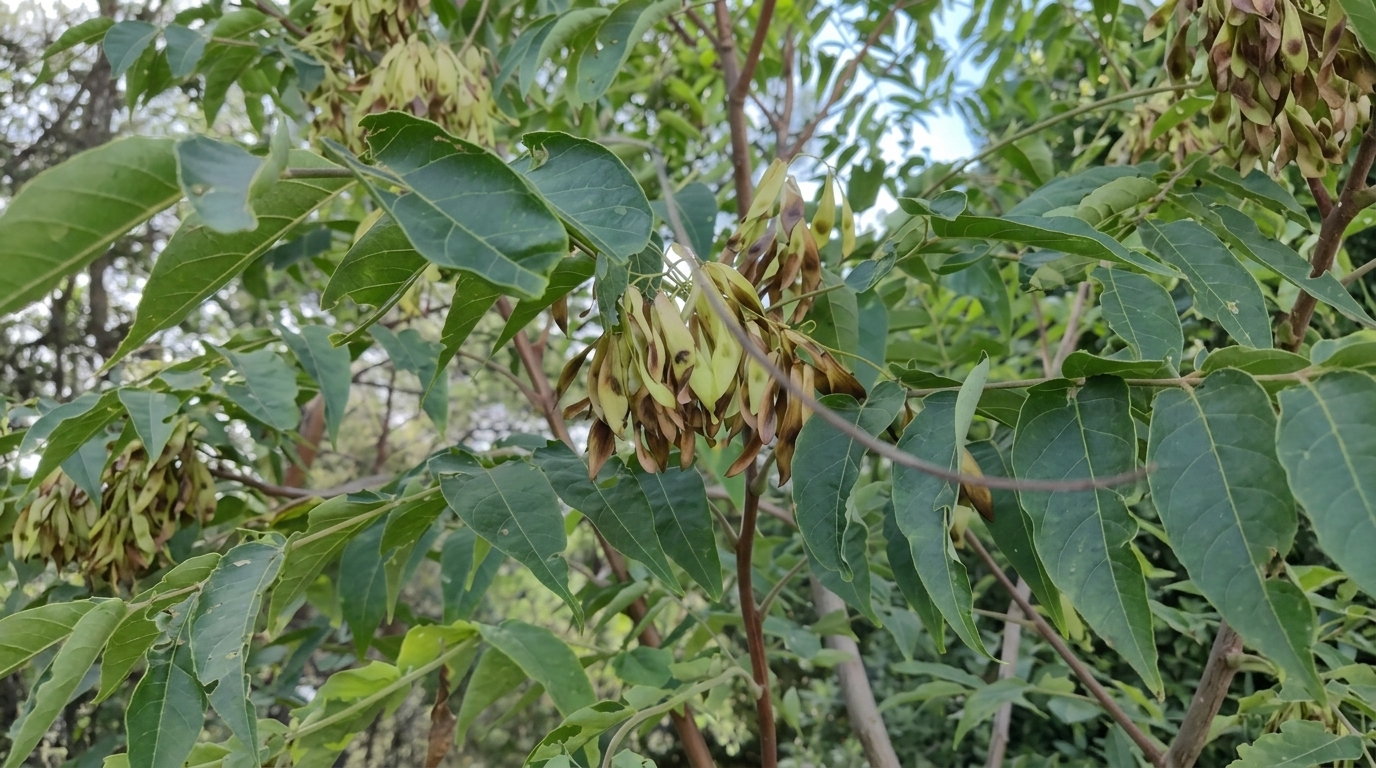
Seeds: flat, elongated, winged seeds (samaras) that appear in huge numbers on female trees. They're yellowish as they ripen and can later turn reddish-brown.
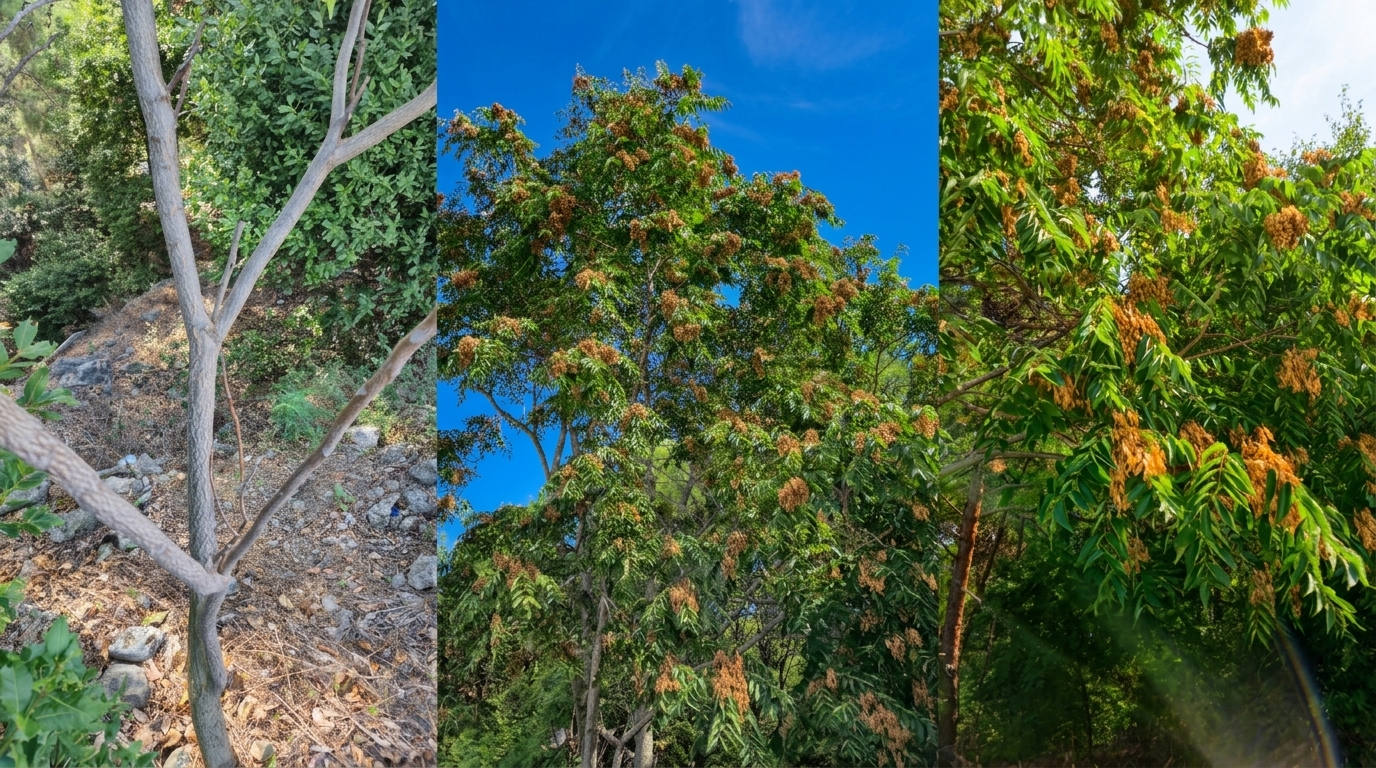
Important: tree of heaven is mildly toxic. In sensitive people, skin contact with the plant can cause irritation or dermatitis (skin inflammation), and the strong smell can cause headaches or nausea. Eating parts of the plant can also be harmful: in people it can cause nausea, vomiting and muscle weakness, while in animals it can lead to drooling, vomiting, digestive problems and lethargy, among other symptoms.
Because of how it looks, tree of heaven is often mistaken for sumac, especially when it's young. But you can tell the two apart by several easy-to-spot features, such as the leaves, the flowers and especially the seeds.
Sumac or tree of heaven? The key differences
We've already covered most of what makes tree of heaven recognizable. But what should you know about sumac?
At first glance, tree of heaven and sumac are easy to mix up, mainly because their compound leaves look similar. Up close, though, there are several clear differences that help you tell them apart.
| Feature | Tree of heaven | Sumac |
|---|---|---|
| Height | Up to 20–25 m | Usually 3–5 m |
| Leaves | Mostly smooth edges | Serrated edges |
| Shoots | Smooth, not hairy | Noticeably hairy |
| Seeds / berries | Winged seeds (samaras) | Dense, red, fuzzy berry clusters |
| Smell | Strong and unpleasant when damaged | Not typical |
| Spread | Aggressively, both by seed and by root suckers | Mainly by root suckers |
The biggest difference, though, is what they mean for forest management and nature conservation. Tree of heaven is a seriously invasive species, while sumac usually poses a smaller ecological risk.
Why does tree of heaven spread so fast?
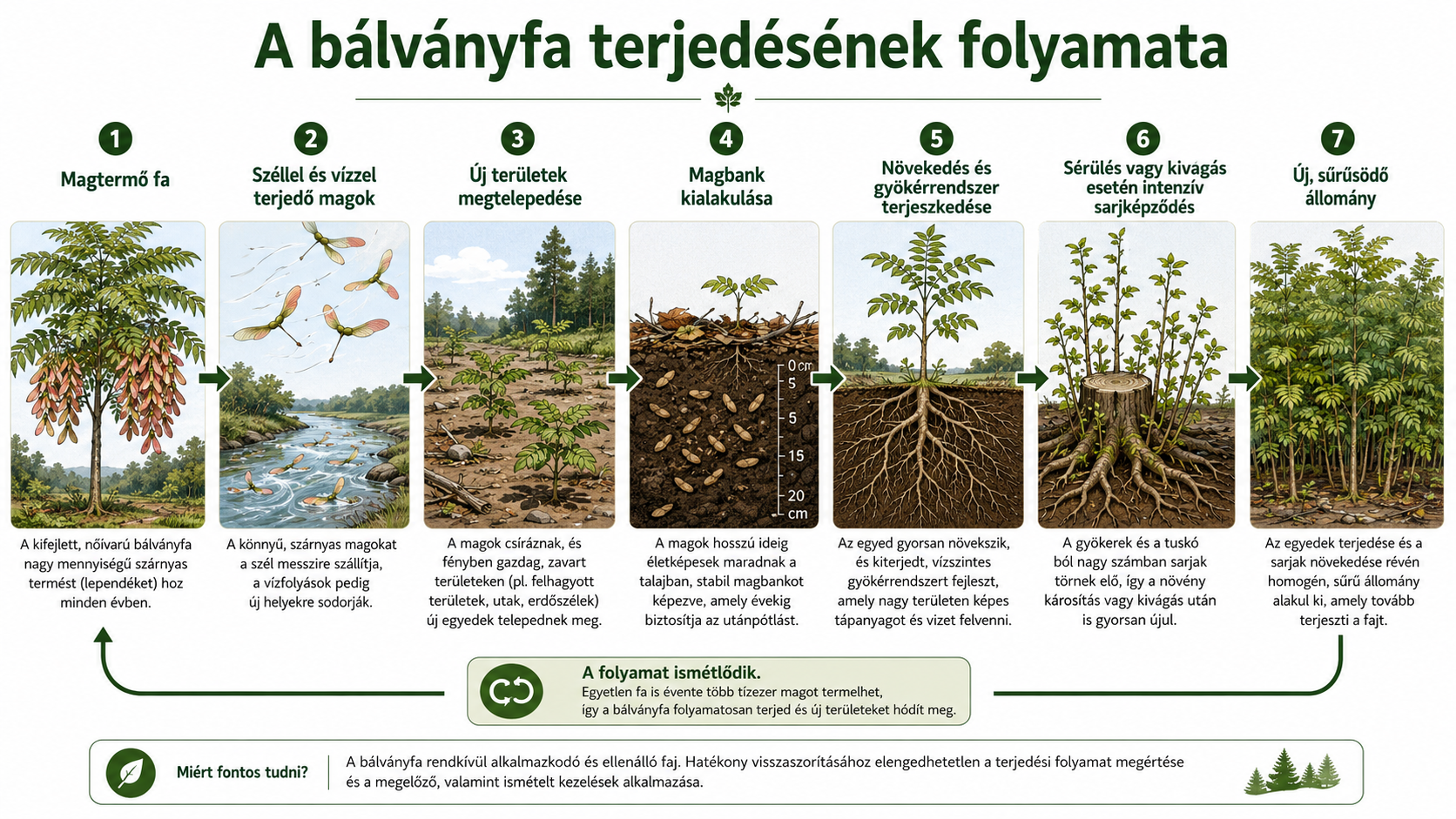
There's no single reason tree of heaven spreads so quickly. Several things work together: it produces huge numbers of seeds, the seeds can travel long distances, it sends up lots of new shoots from its roots, and seeds that stay dormant in the soil can sprout years later.
Huge numbers of seeds help it reach new areas
A mature female tree of heaven can produce up to 300,000 seeds a year. Each seed sits inside a winged samara, which is shaped to be carried by the wind. According to research, the samaras and the seeds inside can travel up to 200 meters from the parent tree, although wind conditions and terrain have a big effect on how far they actually get.
Water can also spread the seeds, especially near streams and rivers. The samaras float, and seeds kept in water still had a 94.4% germination rate after five months.
For forest management, female trees that are already producing seeds matter most. In a 2025 study in the southern Börzsöny hills, just a few seed-bearing trees were enough to start widespread establishment across the 134-hectare study area.
Cutting it down can make it sprout even more
Once a stand is established, it keeps itself going mainly through vegetative reproduction. Tree of heaven sends up new shoots both from the stump and from its roots, and root suckers can appear as far as 27 meters from the parent tree. If the trunk is damaged or cut, or the above-ground parts die, the root system can respond by sprouting heavily. That's why mechanical removal alone won't necessarily get rid of it. Without proper treatment, it can actually trigger a mass of new shoots.
Opening up the canopy can also help it take hold
Sprouting isn't the only thing that helps tree of heaven spread. The right conditions for new seedlings matter too. Gaps in the canopy left by logging or other work let more light reach the ground, which can help tree of heaven seedlings grow. So opening up the canopy near a known infestation without taking precautions can give the species new places to take hold.
Seeds left in the soil can sprout years later
The seed bank in the soil makes control even harder. In one experiment, 50% of tree of heaven seeds were still viable after 24 months, and the study suggests they can survive even longer. In another study, seeds buried in the soil still had an average germination rate of 75% after five years.
This means an area isn't automatically free of tree of heaven just because the visible trees have been removed. New trees can grow later from seeds left in the soil and from roots that are still alive, so successful control takes regular follow-up over several years.
Together, the seed bank and the root sprouting explain why the species can come back even after what looked like a successful treatment.
Because of all this, in good conditions tree of heaven can take over as much as 200–300 m² in a single year.
Why is it important to survey tree of heaven early?
By its nature, controlling tree of heaven isn't one of the easier jobs in forest management. The bigger and more continuous the stands it forms, the harder it gets. That's why an early survey matters. It doesn't just show how large the infested area is. It also lets you plan where and in what order to intervene.
Mapping individual trees, hotspots and continuous stands shows you where treatment will have the biggest effect. Depending on how bad the infestation is, how mature the trees are and what the site is like, controlling tree of heaven may call for mechanical, chemical or other methods, or the right combination of them.
Finding the seed-bearing female trees is especially important. As we mentioned earlier, these trees can produce millions of seeds, which can travel kilometers even in light wind. A single seed source can be enough to start new hotspots. Mapping the seed-bearing trees is an essential part of any effort to slow the spread.
At the same time, control can't be a one-off job. Remember what we said about the seed bank: some of the seeds in the soil can stay dormant and viable for a long time and sprout later. That's why regular monitoring after treatment is important to see whether control is actually working.
How does a drone survey help detect tree of heaven?
Searching for tree of heaven across a large area on foot takes a lot of time and effort. A drone survey lets you check the affected forest stands quickly and consistently. During a survey, MainForest takes high-resolution drone images and processes the data with its own AI-based method.
Using machine learning, individual tree of heaven trees can be detected automatically. The survey can pinpoint them with centimeter-level accuracy. From the data, we create tree-by-tree maps for each forest stand that show where tree of heaven is growing and help you decide which areas need treatment.
The system also works perfectly on a mobile phone, so field crews can use GPS navigation to go straight to the detected trees, without having to walk the whole area first. This is especially helpful in stands where searching on foot is difficult. On top of that, the status of each tree can be recorded digitally during treatment, so you can track the work as it progresses.
Don't put off controlling tree of heaven
Tree of heaven is an aggressive invasive species that spreads extremely fast. Its fast growth and allelopathic effects reduce species richness in forests and the diversity of the canopy. It can also do serious damage in built-up areas. Because it reproduces both from seed and from its roots, it's extremely hard to get rid of.
That's why the first step in effective control is an accurate survey of the infestation and pinpointing where the trees are. MainForest combines drone data collection with AI-based detection, making it possible to map invasive species quickly and accurately even across large forest areas. Based on our projects so far, the system achieves over 97% accuracy.
If you'd like to map tree of heaven or other invasive species quickly and accurately across a large forest area, get in touch with the MainForest team for a custom quote!
Frequently asked questions about tree of heaven
Is tree of heaven poisonous?
Yes, tree of heaven is toxic to both people and animals. Eating its leaves or seeds can cause vomiting, nausea and headaches. Skin contact can cause inflammation or irritation.
Why does tree of heaven spread so fast?
Tree of heaven reproduces very well both from seed and from its roots. Trees start producing seeds at just five or six years old. They live for 40–50 years on average, and a single tree can produce 60,000–70,000 seeds a year, adding up to as many as 10 million seeds over its lifetime. Root suckers grow from roots spreading through the soil and send up new shoots, which quickly make the stand denser and help the population keep spreading. Its root system is extremely good at regenerating, and the root suckers let it spread aggressively.
How can you tell tree of heaven from sumac?
The easiest way to tell tree of heaven and sumac apart is by their leaves, shoots and seeds. Tree of heaven leaflets mostly have smooth edges, its young shoots aren't hairy, and it has winged seeds (samaras). Sumac leaflets have serrated edges, its shoots are noticeably hairy, and it has dense, upright, red berry clusters.
Why is tree of heaven a problem in forests?
Tree of heaven is a serious problem for nature conservation and forest management, because its fast growth, dense canopy and allelopathic effects put native plants at a disadvantage and can crowd them out. In the long run, this can reduce biodiversity and change forest plant communities. In towns and cities, its roots can also damage pavement and some structures.
How can you find tree of heaven in a large forest area?
The most efficient way is a drone survey. Using machine learning, individual tree of heaven trees can be detected automatically. The survey can pinpoint them with centimeter-level accuracy. From the data, we create tree-by-tree maps for each forest stand that show where tree of heaven is growing and help you decide which areas need treatment. During a survey, MainForest takes high-resolution drone images and processes the data with its own AI-based method.

 Phone number:
 Email:
 Address: